

 Teachers plan from resources such as White Rose, Power Maths and The NCETM documents, which allow time to focus on specific skills by teaching in blocked units. These address the aims of the 2014 National Curriculum.
Across all units, fluency, reasoning and problem-solving tasks are used and taught. Specific time and focus is given to all of these elements in lessons.
The class work together on the same key point, whilst at the same time challenging and supporting those children who need it. At Girton Glebe, the children work in mixed ability groups on their table and are encouraged to talk about their work to develop their skills. Teachers are adept at asking precise questions, which ensures that pupils develop fluency with number and are encouraged to think deeply about the underpinning mathematical concepts.
New concepts are taught using concrete and pictorial representations before moving onto the abstract. These allow children to ‘see’ the maths in action; whether this be seeing what a number looks like and the different ways it can be represented, or what the process of calculations look like. By allowing the children to see maths and the mechanics of it, children gain a deeper understanding of what they are doing and why. As such, these pictorial examples support the children to explain and talk about their maths.
Within the lessons, and the independent work sheets that the children do, there are small, coherent steps between questions. These small, coherent steps allow the children to build on their knowledge and be exposed to increasingly more challenging questions as the lesson – and their independent work – progresses. These small steps allow, and encourage, our children to make connections across mathematical ideas to develop interconnected understanding.
Maths vocabulary is used in every lesson to develop children’s understanding. Stem sentences are used where appropriate and children are encouraged to answer in full sentences.
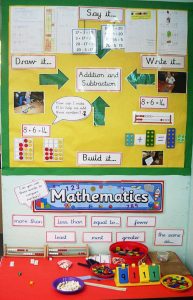
Every classroom contains a maths working wall divided into Build It, Draw It, Say It, and Write It.
Challenge and Support
Pupils who grasp things quickly are challenged through problem solving instead of being accelerated onto new content.
Additional support is given through models and representations, questioning and rapid intervention.
All calculations follow the calculations policy.
Rehearsal
Each Maths lesson starts with ‘White Rose Flash Back 4’. These are 4 – 5 questions that are not a focus of the current learning; rather, they are a way to revisit and keep fresh what has been previously taught. These might be concepts from the previous year group, or earlier in the year. This means that shape, position and direction and measurement will be continually visited throughout the year and not just when taught as the unit focus.
Developing Fluency with number facts
Every maths lesson begins with fluency tasks, to build the speed and efficiency of number facts that the class – and year group – are working on. These are tasks that are specified in the National Curriculum for each year groups.
We use Daily Ten Topmarks https://www.topmarks.co.uk/maths-games/daily10 to rehearse number facts and times tables. Classes will work on a specific times table – or number fact – for a while (whilst still revisiting previous ones learned) before moving on to new times table facts.
Statutory Requirements
Foundation Stage (Reception)
Our children will:
- Recognise numerals and count objects to 10.
- Be given opportunities to count groups of objects and find the total of them.
- Be exposed to mathematical vocabulary across all areas of the EYFS environment.
- Use mathematical vocabulary relating to numbers, shapes, position and direction.
Key Stage 1 (Years 1 and 2)
Our children will:
- Develop confidence and mental fluency with whole numbers, counting and place value.
- Develop their number bonds to 20.
- Work with numerals, words and the four operations, including with practical resources.
- Develop their ability to recognise, draw, describe, compare and sort shapes using the related vocabulary.
- Use a range of measures to compare different quantities e.g. length, time, money.
Lower Key Stage 2 (Years 3-4)
Our children will:
- Become increasingly fluent with whole numbers and the four operations.
- Develop efficient written and mental methods and perform calculations accurately with increasingly large numbers.
- Solve a range of problems, including with simple fractions and decimal place value.
- Develop mathematical reasoning so they can confidently describe the relationships between numbers and shapes.
- In Year 4, pupils should have memorised their multiplication tables up to and including 12x12.
Upper Key Stage 2 (Years 5-6)
Our children will:
- Extend their understanding of the number system and place value to include larger integers.
- Develop connections between multiplication and division with fractions, decimals, percentages and ratio.
- Solve a wider range of problems with increasingly complex properties of numbers.
- Become efficient and fluent in written methods for all four operations.
- Use vocabulary accurately across all areas of maths.


You must be logged in to post a comment.